Project 01 / Software systems
Edge Evidence
Reliable processing. Verified copies.
A clearer view of what the system has actually done.
01 / The question
What should
“done” mean?
A system can say that work finished. A reviewer still needs to know what happened, what can be checked, and whether the copied result matches its source.
Edge Evidence explores that handoff. Processing, copying, verification, and inspection have separate responsibilities. The demonstrations make those boundaries visible without using private evidence.
02 / The design
Two views.
Different jobs.
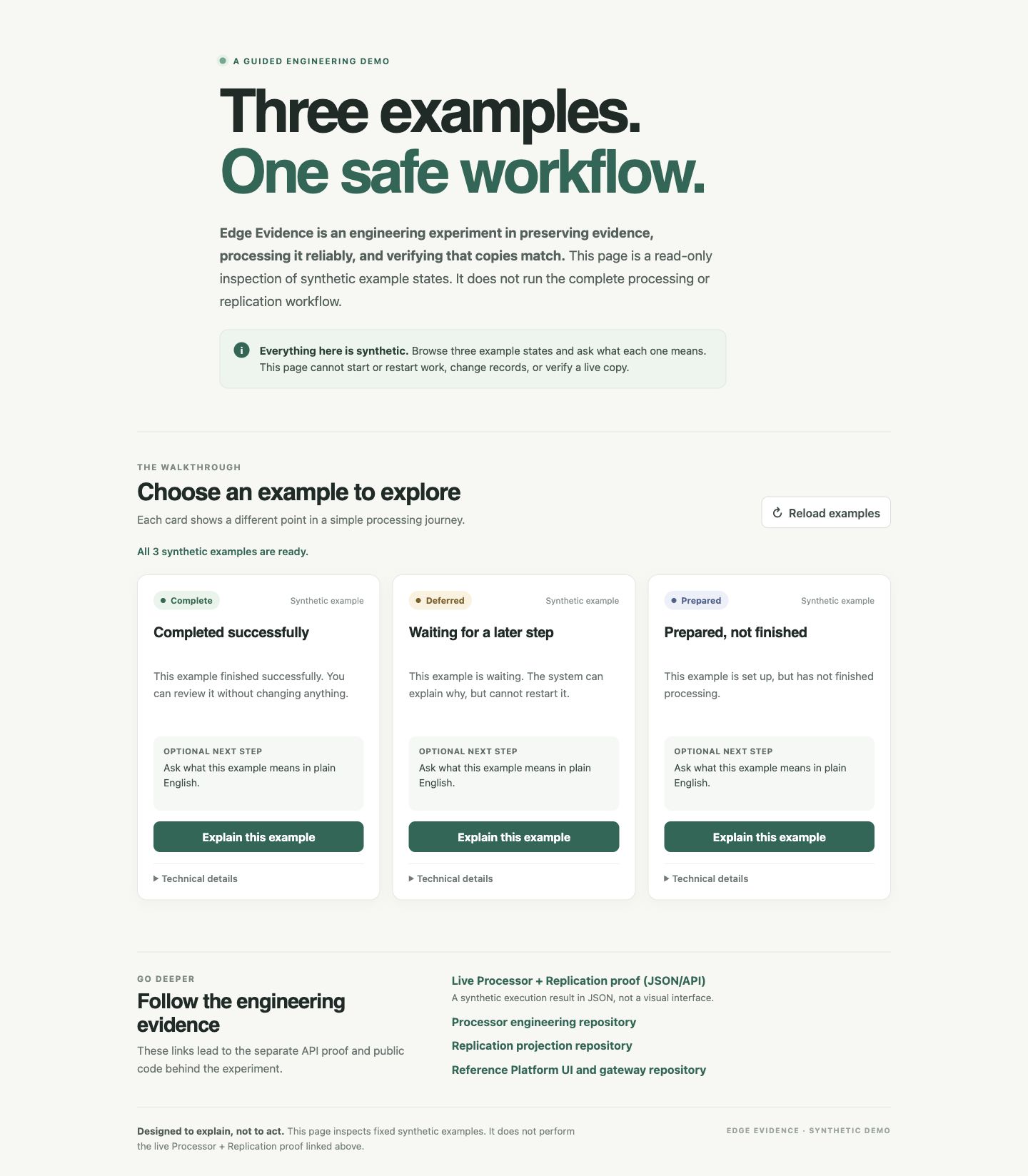
The visual page explains example states. The execution proof records a synthetic processing-and-replication result. They are complementary demonstrations, not one continuous workflow triggered by the UI.
Application responsibilities share one hosted demo runtime. This is not a claim of production-grade service isolation.
The JSON endpoint returns an execution result that may be cached. Opening it is not a promise that a fresh run occurs.
03 / Try the work
Start visually.
Then go deeper.
Visual / Read-only
Three example states
Explore completed, deferred, and prepared examples. Use Explain to understand a state and what a reviewer could inspect.
The page cannot start or restart work, change records, or verify a live copy. “Edge Agent” here means deterministic inspection—not an LLM making decisions.
Technical / JSON API
An execution result
Inspect synthetic processing, a verified handoff, replication, and independent readback. Replay records no new writes.
This is structured JSON, not a visual application. The result may be cached and is separate from the three UI examples.
04 / Honest boundaries
Implemented.
Not overstated.
Implemented: the public Web UI, synthetic Evidence API, deterministic inspector, and the separate Processor + Replication demonstration.
Limited: synthetic inputs, a single-runtime visual gateway, and no claim of production availability or persistent hosted evidence storage.
Proposed: LLM-powered inspection experiments such as ADK + Ollama. They are not running in this hosted inspector; no results are claimed.
Why does the inspector explain rather than act?
Classification and authorization are different responsibilities. A state can be described by predefined rules without granting permission to mutate evidence or restart a worker. The hosted gateway keeps that boundary explicit.
For a plain-English explanation of the inspection boundary, read Agent vs deterministic inspector. It separates rules, language models, tool use, and permission to act.
05 / Follow the implementation
Public code.
Clear responsibilities.
Implementation sources for the inspection boundary
The public inspector HTTP surface identifies deterministic, read-only inspection and reports mutation authorization as false. Its Evidence API describes synthetic projections, not an evidence authority or worker executor.